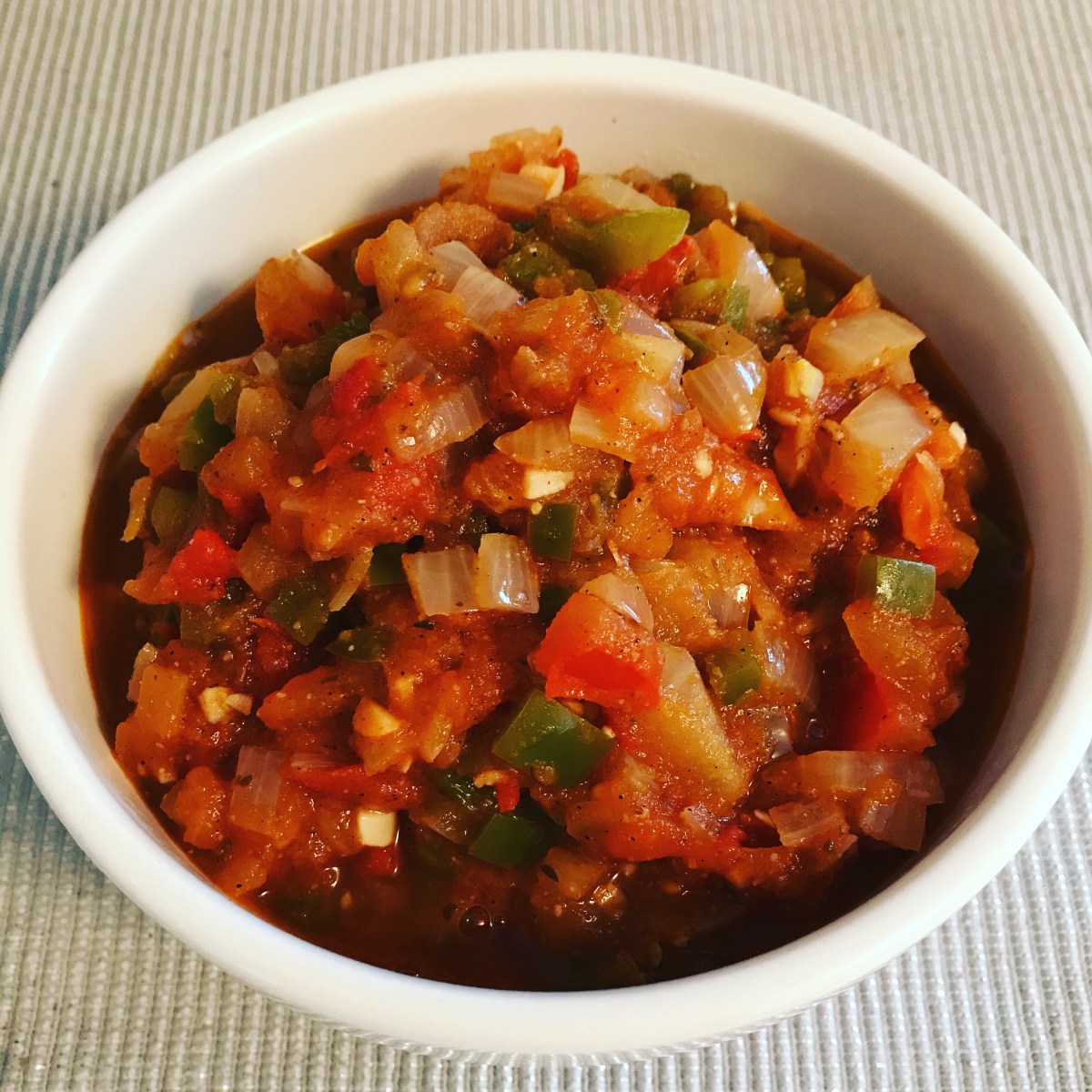
Tomato salsa

This basic salsa can be eaten hot or cold, and is perfect as a dip with some tortilla chips or as one of the fillings for fajitas.

Tomato salsa
3-4 large tomatoes
2 onions
1 green pepper
1 small (hot) green chilli
3 cloves of garlic
2 tbsp tomato purée
2 tbsp lemon juice (1 lemon)
2 tsp cumin powder
1 tbsp caster sugar
1/2 tsp salt
1/2 tsp black pepper
1 tbsp dried oregano
1 tbsp vegetable oil

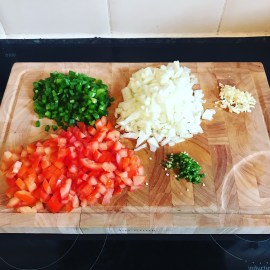
1. Finely chop the garlic and chilli. I also use the seeds from the chilli. Chop the onion, pepper and tomatoes into small pieces.

2. Place all the chopped ingredients in a pan with the vegetable oil, and add all the spices / herbs. Fry for about 10-15 minutes, stirring occasionally.

3. Add the tomato paste and and the lemon juice, and mix in with the other ingredients.

The salsa is ready to be eaten immediately, or you can cool it to use it as a dip.

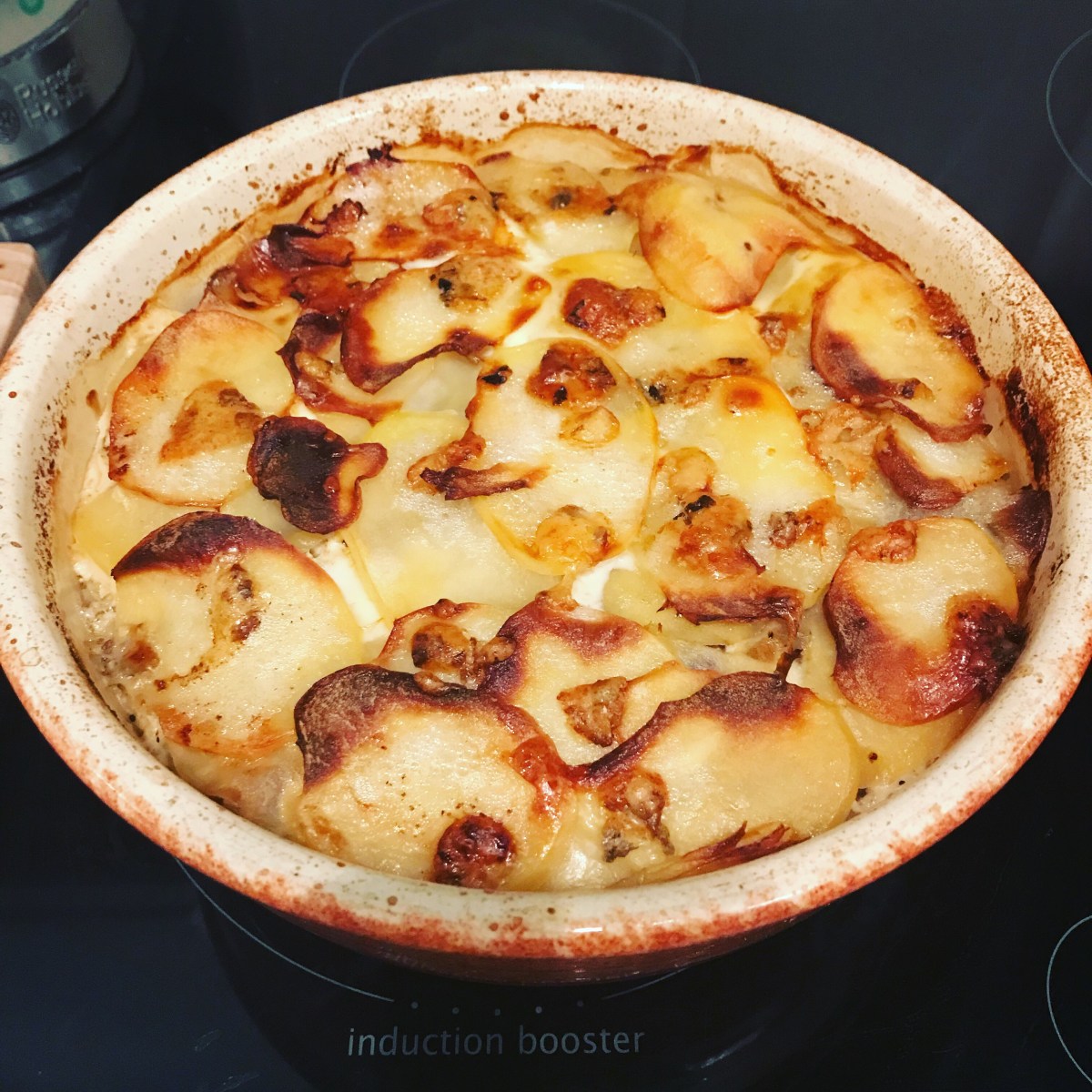
Mince beef and potato bake

This is simple home cooking. Easy and quick (in preparation), and will be enough to take as lunch to work too. Now, I spent a great while trying to think what to call this dish. I couldn’t really come to any good definitive conclusion of what would be best, most describing name. I’m happy for anyone to give me suggestions on this. My mum used to make this when I was a child. She would always make two version: one with blue cheese for adults, and one without for the children (I’m the second oldest of five). These days, I always make mine with the blue cheese, but this can easily be left out if you’re not a fan.

2 onions
500g mince beef
6 medium to large potatoes
50g blue cheese (I used Roquefort)
5 dl milk
3 eggs
salt and  black pepper
ground allspice, white pepper, paprika (optional)

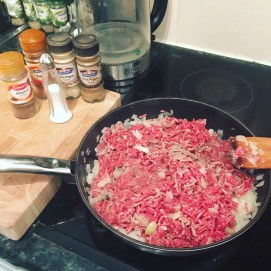
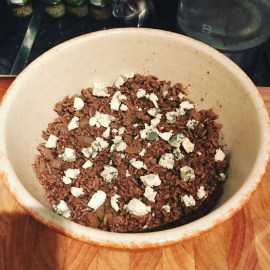
1. Finely chop the onions, and fry in vegetable oil in a pan until they start to get translucent. Add the beef and mix with the onions. add spices of your liking. I tend to always use salt, black pepper, white pepper, allspice and paprika on my basic mince beef for various different foods. Cook until the beef is ready, breaking it into small bits as it’s cooking.

img_1975

2. Peel and slice the potatoes. Layer about a third of them at the bottom of an oven dish. Then put half of the mince beef as the next layer. If using blue cheese, add half of it on next. Then a layer of half of the remaining potatoes, remaining mince beef and remaining potatoes on top.

img_1972

3. Mix the eggs and milk with a fork, then pour over the potatoes / mince beef. If using blue cheese, add the remaining half on top.

img_1970

4. Cook in preheated oven 180°C / 355° F for about an hour, until the potatoes are soft.

img_1971

Karelian pie (not really a pie)

This Finnish “pie” is one of those foods I’ve had to learn how to make myself because of living abroad, to ensure availability when I would like some. It’s right up there with one of my all time favourites, salmon soup. These days, only the pies from the actual Karelia area can officially be called as Karelian pies, but to me they are all called this. When Gordon Ramsay tasted it and thought it was awful, he must’ve hurt every Finnish person’s feelings. To be honest, I do have to wonder if his comment was for the sake of the cameras. Everyone must’ve been thinking what version of this food was he served, as I don’t know anyone who doesn’t like Karelian pies.

Even though the name says ‘pie’, it’s not really one. I was trying to think how to translate it (with the help from my British husband), but nothing seemed to fit. We went through pasty, pie, pastry etc and concluded that pie was still the best option.

Basically, this pie is something with very thin rye (and wheat) flour dough base, with cooked, savoury pudding rice in the centre. Very often, it’s enjoyed with butter that has hard boiled, crushed egg mixed in.

Filling
3 dl pudding rice
3 dl water
12 dl milk
2 tsp salt
Dough
4 1/2 dl rye flour
1 dl plain wheat flour
2 tsp salt
2 dl cold water

1. Put the rice, salt and water in a pan. Cook until the rice has absorbed all the water. Add the milk, and cook for half an hour. Once cooked, cool.

2. Whilst the rice is cooking, mix all the dough ingredients together. You don’t want it to be dry, but not sticky either.

3. Roll the dough into a tube, and cut in half. Repeat twice, then cut each piece in three equal sizes. After these steps, you should end up with 24 fairly equal size pieces.

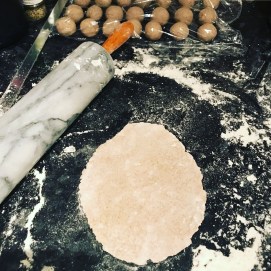
4. Roll each piece into a ball. Cover the balls with cling film to stop them from drying. One by one, flatten each ball by hand, then using a rolling pin roll into very thin, oval shapes.

5. Put rice filling on the centre of the dough, from one end to another, leaving unfilled dough on the sides.

6. Turn the furthest end of the dough from you over the filling, then the sides. Pinch the dough between your fingers as you’re moving towards the closer end to you (picture is of a cooked pie, as I forgot to take a picture before putting them in the oven, but it should still give you an idea).

7. Cook in oven 250°C (fan) / 480°F for 15 minutes.

8. Put some milk and butter (25g-50g) into a pan, and warm until the butter has melted. After you take the pies out of the oven, bathe each pie in the milk-butter mix, turning it so that both sides are fully submerged during the process.

French onion soup (with meat)

I remember the packet French onion soup from my childhood, that was used to enhance other foods, but we never ate it on its own. So I was intrigued to try to make my own, to see if I could change my mental image of this famous soup. As this soup requires beef stock, and for this kind of food I don’t like to use ready made ones, I made my own stock, and then decided to add some of the leftover meat into this soup, which actually worked really well.

1 litre beef stock Beef broth (stock)
4 large onions
25g butter
2 tbsp olive oil
1 tbsp caster sugar
3 tbsp cognac or brandy
150ml red wine
1 bay leaf
salt and black pepper to taste

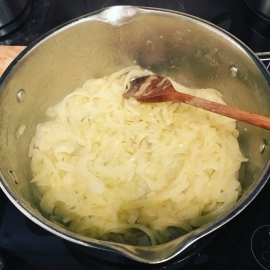
1. Peel and cut the onions in half, then slice thinly. Put in a pan together with the butter and oil. I think quite a large, deep pan is good for this, due to the flaming at later stage. On a low temperature, fry the onions for 20 minutes, until soft, stirring from time to time.

img_1921

2. Add the sugar, and fry, stirring occasionally, for another 20 minutes.

3. Add the cognac, and carefully set alight. I used long matches. At first, the flames will be quite big so stand back. They will however quickly reduce. The flambéing process reduces the alcoholic content in the food, whilst still keeping the flavours of the drink.

img_1922

4. Once the flames go out, add the red wine, stock, bay leaf, salt and pepper. Bring to boil, and simmer, covered, for 20 minutes.

5. Check the taste, and add salt and pepper if required.

6. As I made my stock particularly this soup in mind on the same day, I had all the meat left. Even though this soup is slightly sweet, I decided to add some of the meat into the soup. I just added the cooled, stripped meat pieces straight into the soup in the serving bowls.

Restaurant review: Fera, London

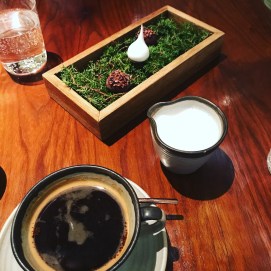
This restaurant is most of the time fully booked, and it’s easy to see why. As you step into the luxurious Claridge’s Hotel in Mayfair, in Central London, you can already get an idea what décor and ambience is waiting for you at the actual Fera restaurant. The food is worthy of their 1 Michelin star, with great attention to detail applied. For each course, before actually placing anything in your mouth, the food has already visually satisfied your tastebuds.

The overall experience was as great as we remembered from our last visit, however there were few things that appeared a little too salty to our taste. The new Head Chef Matt Starling has done a great job at maintaining the standards this restaurant had under Simon Rogan. Not to mention, we went on a Saturday between Christmas and New Year, and I was so pleased that our Tasting Menu didn’t have ingredients that were leftovers from Christmas meals, but something completely different.

Another thing to mention, that is a good example of the quality of the place, is that from on our booking we had had an offer for free glasses of champagne. The champagne itself wasn’t any cheap version, but Laurent Perrier (our favourite brand we often buy). The kitchen tour we had afterwards was really interesting, it was great to get some insight to their preparation process. The service at Fera was really good. The staff were very skilled at reading us, being formal, but also informal.

For bread we had rye and stout bread (my husband particularly loved this), as well sourdough bread, which I thought very tasty, more than at most places. And our first test of a place of the softness of the butter was passed by flying colours, however it was too salty for us.

For appetisers we had a wonderful chickpea and rosemary wafer with cream cheese and mustard vinaigrette (that brought nice sharpness) with edible flowers. Everything worked very well together, and was extremely pleasing to the eye.

The starters of stewed rabbit with lovage, and scallop with John Dory and smoked roe were served a little bit like appetisers. The rabbit was very juicy. It was coated with dried onion, and served with lovage purée. It was a little messy to eat as you ate it by hand and it was bigger than one bite, but the flavour was really good. I also loved the smokiness of the seafood ‘tart’.


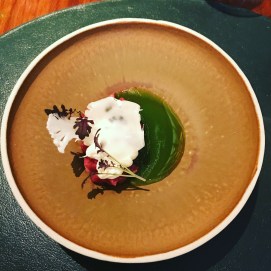
The second starter was beef tartare. It was very mild in flavour, but very enjoyable nevertheless. The whole dish was executed well, and all the flavours went really well together. We were also having the wine pairing for our menu, and were originally surprised to be served white wine with this course. The unexpected sharpness of the wine actually complimented the food extremely well.

For the fish course we had brill. It was juicy, but for me perhaps slightly overcooked. Something on the plate was too salty for us. We came to a conclusion it was the broccoli purée.

The main meat dish presented us with deer. I think this might be the best cooked deer I’ve ever had. As the meat of this animal is very lean, it can very easily become dry. Ours, however, were melt-in-the-mouth soft, tender and juicy. The blackberry element on the dish was powder, and it was also incorporated in the jus, however we felt it would’ve been nice to have couple of the actual berries on the plate, too. When the dish was served, all the other ingredients were hiding inside a king lettuce parcel. When you revealed what was inside the sight filled you with joy. Again, this dish, too, had something that was too salty. On this dish it was the mushroom purée.


The first dessert, a little bit like palate cleanser but with less sharpness and freshness, was bergamot foam, parsley cream and honey cake. On it’s own, I wasn’t a big fan of the parsley cream, but when you ate everything together all of the flavours complemented each other really well. The cake was like the currently trendy dehydrated cake, with nice crunch to it.

The main dessert of chocolate custard ganache, earl grey ice-cream, aerated milk cake and lemon granita was nice, however something didn’t entirely work for me. I think it might have been the ice-cream. Overall the dish was still nice enough.

Petit Fours were nice, my husband in fact couldn’t even wait for me to take the picture until he’d already had one.

img_1874

Rating: ★★★★☆

Beef broth (stock)

The key to a good broth is slow cooking and bones (although you always also need some meat too). It can be very easy by throwing everything in together from the beginning and simmering for 2-3 hours, or with a little bit more effort you will end up with a wonderful, clearer stock.

1.1 kg beef short ribs (the more bones the better)
1 tsp black peppercorns
1 tbsp sea salt
1 medium to large onion
1 carrot
1 celery stick
2 bay leaves
2 thyme sprigs
1 rosemary sprig
4 garlic cloves
3 litres of cold water

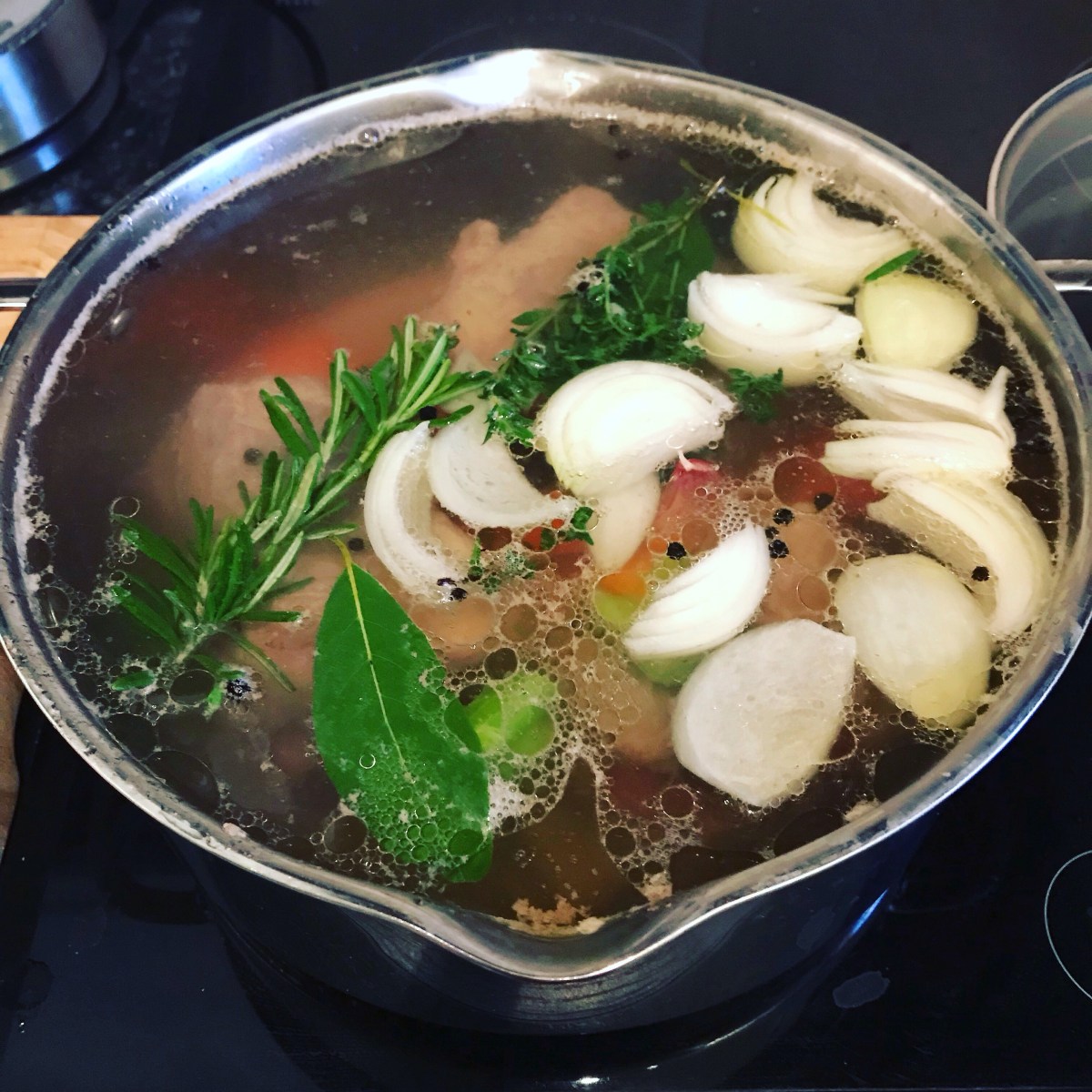
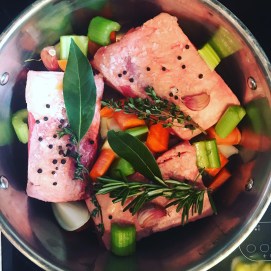
1. Place the ribs in a large pan. The more bones you have the better it is. You could, for example,  have one rib with meat on and rest of it bones. Cover with the water, and add salt. Slowly bring to simmer, but don’t boil. Muck will start surfacing. Skim this off. The process should take about 20-30 minutes.

img_1897

ALTERNATIVELY, place all ingredients in the pan. Cover with the water, and bring to simmer. The muck will stay in the broth, making it cloudy.

2. Once no more muck is rising to the surface, add all the other ingredients. Cover with a lid and simmer for 2-3 hours.

img_1898

3. When ready, strain through a sieve. I also use a piece of muslin to make the stock even clearer. Keep the meat aside, to be used in other foods.

4. Cool the stock, then chill in the fridge. This will make the excess fat harden on top. Remove the hardened fat and discard.

img_1916

Restaurant review: Gauthier Soho, London

I’m sad to be writing a review of this charming old townhouse, located right in the heart of buzzing Central London, Soho. Sad because it unfortunately cannot be as good as I wanted it to be. We have been here several times, and always think it as one of the nice places we go back to. They do a fantastic value reduced Tasting Menu for lunch, which has been getting us going back for more over and over again. This time we went for dinner, and for some reason the overall experience seemed underwhelming, and I remembered thinking the same last time we visited. You couldn’t really pinpoint why you were left feeling like this, but the meal somehow left you wanting more, as if something hadn’t been satisfied (we were completely full after the meal, so the quantity wasn’t it). As a fine dining restaurant, it felt like the attention to detail wasn’t present (this is important part of a fine dining experience), from dressing of the plates to service. New cutlery wasn’t laid down neatly, but very messily. Messy / sloppy was also the word for some of the plating. And when it comes to wine pairing, we very rarely have any criticism to say, however with this meal also some of the pairings didn’t work. We arrived 5 minutes early for our first seating slot, and were asked to wait outside on the street, in the cold (luckily it wasn’t raining). I have in the past successfully predicted some restaurants to lose their Michelin stars, and would also have predicted it for Gauthier Soho. On closer inspection, they in fact have already lost it.

There was a good selection of fresh bread, I had white roll which was light and fluffy, and flavoursome. My husband had beetroot brioche roll. Again, soft, light and fluffy, but the beetroot didn’t really bring any additional flavour. One of the first things we assess a restaurant by is softness of the butter. I don’t hate many things more than hard butter you can’t spread when in a restaurant. In a lot of nice places the butter is amazingly soft and fluffy. Unfortunately, at Gauthier Soho, the butter was hard.

I was glad to get the appetisers, as I was really hungry. The parmesan crisp was nice, thin and crispy. The quinoa crisp with beetroot hummus was nice and tasty. The last thing, which remained unknown to what it was, was ok, I couldn’t taste the wasabi that was promised.

First course was a carrot tartare. We loved the theatrics that followed. What appeared to be a meat mincer was brought to the table. Condiments were placed in front of you (guacamole, finely chopped shallots, ginger and something else we weren’t sure of what it was. On a plate in front of you, you had plum jam. The waiter then brought carrots, holding them on the green stalks, and proceed to mince the carrots in the mincer in front of you. The mince was then placed on your plate, on top of the plum jam. You then added the condiments of your liking, and mixed everything together, to be enjoyed with lovely thin and crisp Melba toast. I added everything to mine, however not all of the ginger. I found the taste of this all a bit weird, and wouldn’t rush to have it again. The carrot itself was soft and juicy.

Next course was scallop with cauliflower, roe crisp and romanesco. The scallop was nicely cooked, however the star of this dish without a doubt was the crustacean sauce. Full of flavour, this was one of the best elements of the entire meal. The wine had quite a floral taste, and perhaps not something I would pare with this kind of dish.

Next up was truffle risotto. This has been one of my favourite dishes of this restaurant for as long as I can remember. I thought the risotto was cooked well, just a bit al dente as it should be, however my husband thought it was a little too cooked. Risotto was nice an creamy, and had a generous amount of black truffle.

The meal then continued with a fish dish of halibut. This was the best dish of the meal. The fish was cooked well, however I’m still trying to decide if mine could’ve been cooked slightly less. My husband thought the fish was cooked perfect. It was moist and soft. There was pickled beetroot with the fish, which was nice on its own, however I’m not sure if it was the best accomplishment for the fish, as the sharpness overpowered the delicate flavour of the fish. We were also served quite sharp red wine with this dish, which we didn’t think suited the dish, as this too overpowered the fish.

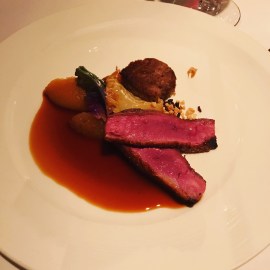
I’m not entirely sure what to say about the next dish of Barbary duck. It wasn’t bad by any means, but it wasn’t magnificent either. It just left you a bit underwhelmed I guess. The duck itself was cooked well (medium), and one of the accompaniments of what seemed to be swede purée went really well with it. I did enjoy the slow cooked meat ‘cake’.
Next came Gruyere cheese with fennel and chestnut. The cheese was very nice. I’m not usually a great fan of fennel (same with my husband), it can sometimes be quite pungent, however this was very thinly sliced and brought great freshness to the dish, and what you wanted at this stage of the meal. The chestnut was ok, the apple balls were a bit hard.

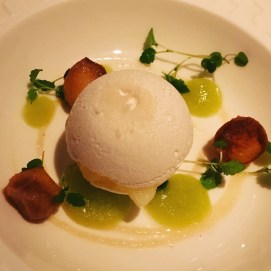
The first dessert was a palate cleanser. The light, airy shell was meringue-like, but completely vegan, made of chickpea water. It was filled with sharp pear sorbet, and also served with pear purée and lemongrass purée, as well as pear bits. Overall quite sour (perhaps a bit too sour), but refreshing.
The main dessert was Golden Louis XV. This decadent, very sweet dessert would satisfy the most demanding chocolate lovers, I’m sure. Light, but crunchy base, topped up with two different layers of chocolate, with a rich chocolate glazing and edible gold decoration, this is a wonderful dessert, however after a big meal you may struggle to eat it, however you won’t be able to stop trying!
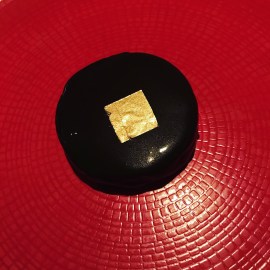
The whole meal was finished with petit fours.

Rating:★★★☆☆

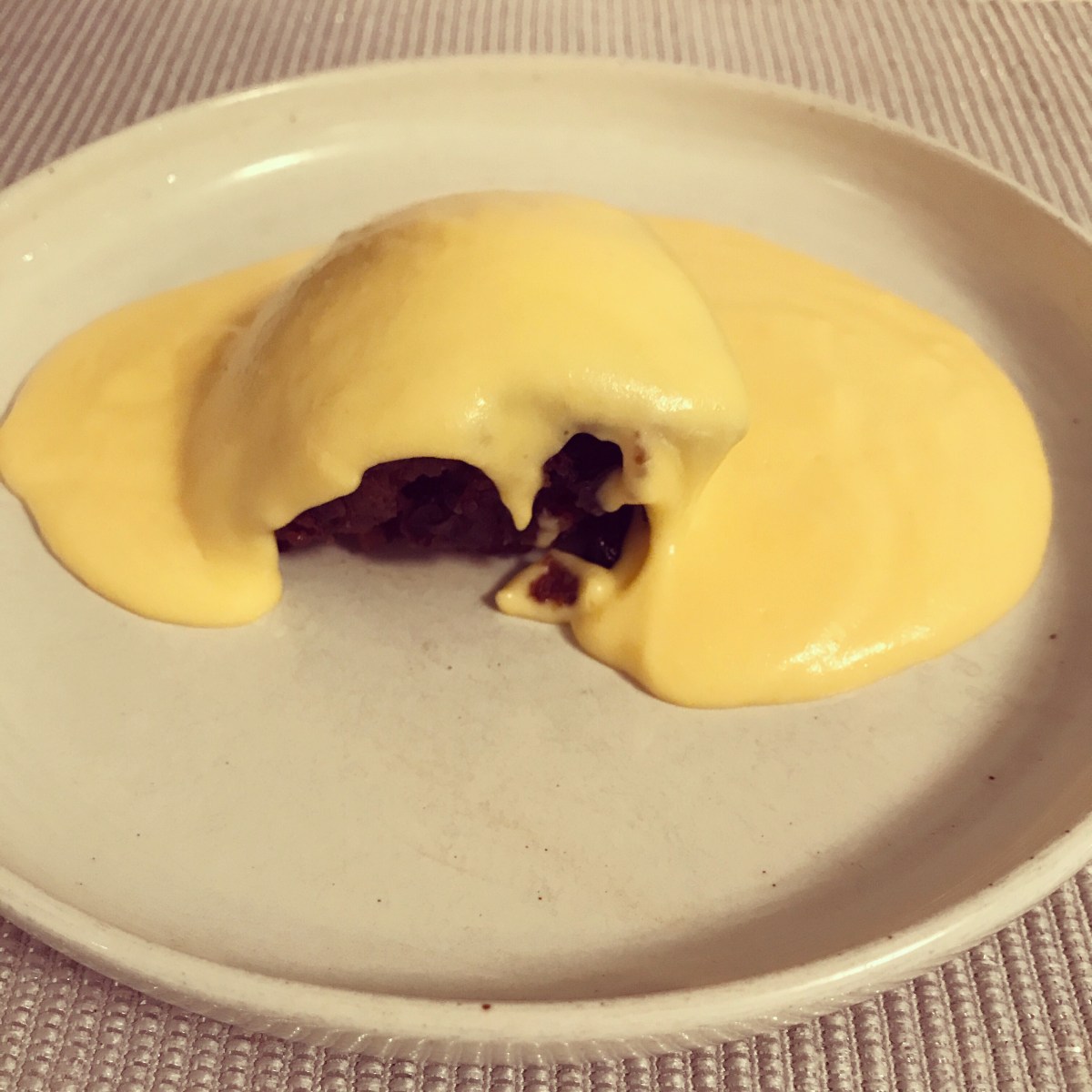
Thick vanilla custard

I was never that keen on custard in the past, when my experience was from pub desserts with this sauce. My husband was sometimes requesting this, so I finally decided to have a go. The first time I made it, I was amazed at how good it was! None of that tasteless from a packet stuff, but oh so wonderful, proper, creamy custard. This is still to date the best custard I’ve ever tasted, and I also use it for my trifle. I would strongly recommend this for anyone wanting a nice, thick custard. And it’s really easy to make too. Perfect accompaniment with your Christmas pudding, apple pie or rhubarb crumble, or whatever else is your favourite.

300ml double cream

3 egg yolks

2 tbsp caster sugar

1 tsp potato or corn flour (any starchy flour for thickening)

1 tsp vanilla extract

1. Heat the cream in a pan until steaming, but not boiling. If you don’t stir it during this time, you will get a skin on top you will want to remove. I tend to stir the cream during heating.

2. While the cream is warming, mix all the other ingredients together in a bowl.

3. Pour the cream onto the eggs on a thin strip, stirring continuously as you pour. Then pour the whole mixture back into the pan.

4. Over medium heat, stir until the mixture thickens (5-10 minutes). I don’t usually get lumps, but if this happens, the custard can be passed through a sieve.

Then it’s time to enjoy the best vanilla custard to date!

Liver casserole

This dish is food that’s eaten in my native Finland any time of the year, and in my family also as part of the Christmas meal. I always thought this food to be something of an acquired taste, and every time I used to host a party I would tell the British guests that I will not be offended if they don’t like it and finish it. As it’s turned out, it has actually always been one of the dishes people love. It’s not the most beautiful food in terms of presentation (I admit it does look more like dog food), but sometimes the taste can speak for itself instead. This dish is normally served with lingonberries, or lingonberry jam. I would say the closest substitute to lingonberries would be cranberries, which are probably more widely available.

3 dl pudding rice
1 litre water
3 tsp salt
8 dl milk
2 eggs
2 onions
1tsp ground white pepper
1 tsp dried oregano
1tsp dried marjoram
3 tbsp dark syrup (I had to replace this with 2 tbsp treacle due to availability of the syrup I normally use, and it worked fine)
1 1/2 dl raisins
500g beef liver (Pork is fine too. Beef liver will give smoother flavour, pork stronger)

1. Boil the rice in the salted water for about half an hour. You may want to stir it from time to time so that it doesn’t stick to the bottom.

2. Peel and chop the onions, and place in a blender. Roughly chop the liver pieces, and check for any sinewy parts you may want to discard. Place in the blender together with the onions. Blend until the liver doesn’t have firm texture anymore. The onions can still be in small pieces.

3. Once the rice is cooked, add the cold milk, and all other ingredients. At this stage the mixture will be very liquid, but when it’s cooked it will become firm.

4. Pour the mixture in a buttered oven dish, and add some small pieces of butter on top. Cook for about on hour 180°C / 355°F.

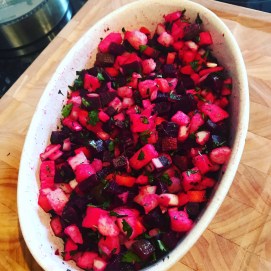
Rosolli (beetroot salad)

After any festivities, and overindulging, many of us are choosing the lighter leftovers for a snack. This beetroot salad is exactly what we need. For some reason, this particular salad is only seen on the Finnish table around Christmas time. I think the flavours are actually completely suitable to any time of the year. You get sweetness from the beetroot, saltiness from the pickled cucumber and freshness from the apple. Together with the other ingredients it all comes together like a perfect symphony.

1 salty gherkin
3 beetroots
1 carrot
1 small onion
1 medium size salad potato
1 sharp apple, for example Granny Smith
half a bunch of fresh parsley

1. Boil the beetroots in boiling water for about an hour. Once cooked, pour the hot water off, and cover the beetroots with cold water. You can now rub the skin off very easily, whilst submerged in the cold water.

2. Boil the potato with skin on, until just cooked, take care not to overcook. Once cooked, peel the potato and chop into small pieces. Peel the carrot, and boil until just cooked but still firm. Cut into quarters lengthwise, then cut into cubes.

3. Finely chop the onion, and cut the gherkin into quarters lengthwise, then chop into cubes. Finely chop the parsley.

4. Cut the apple into wedges. I tend to do this first, and then peel each wedge, but you can also peel the whole apple first. I then cut the inside edge off, where the core is. Finally, chop into cubes.

5. Mix all ingredients together. For more flavour, leave in the fridge overnight before serving.